Lesson of the Day 73: The Moveable Alphabet — Building Words and Sentences, One Letter at a Time
Published on: May 13, 2026
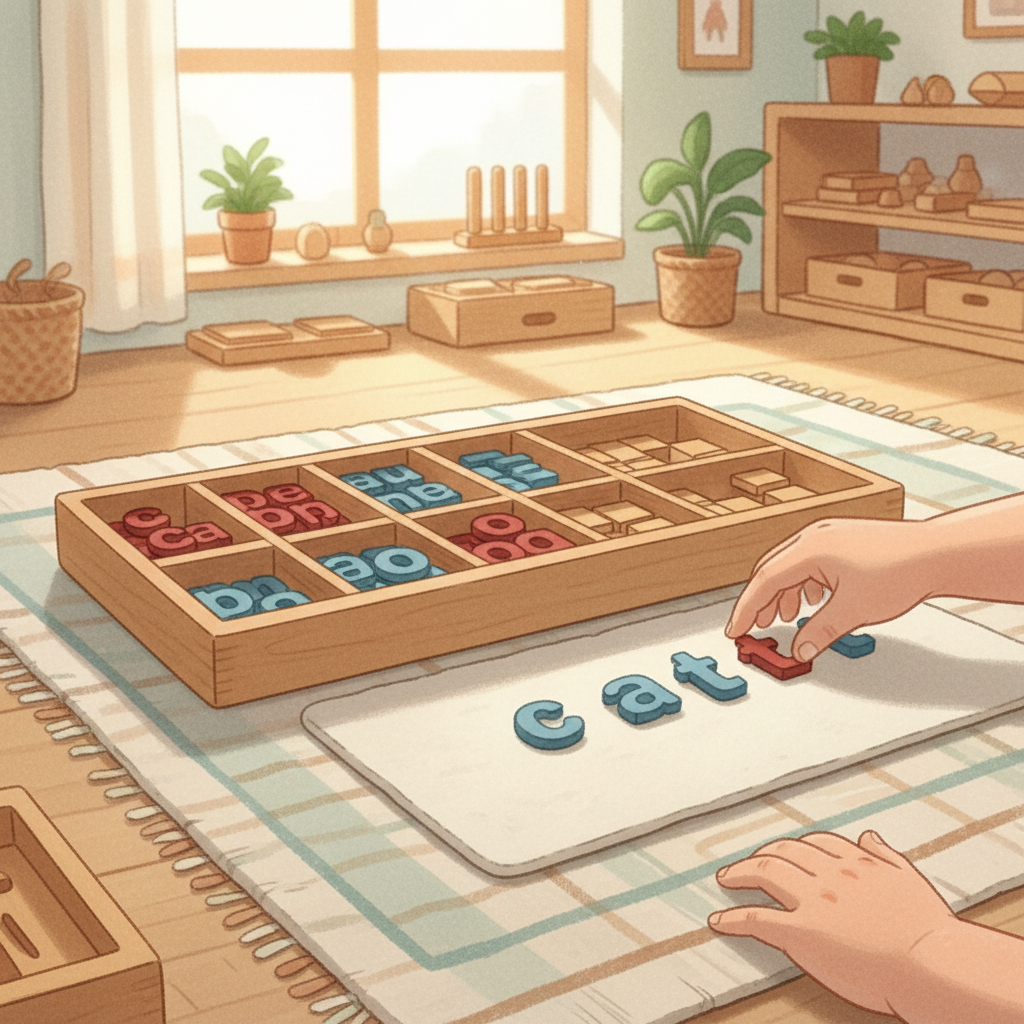
"What the hand does the mind remembers." — Maria Montessori
Welcome back to Lesson of the Day #73! Today we're opening one of the most magical boxes in the Montessori classroom — the Moveable Alphabet. If you've watched your child trace sandpaper letters with their fingertips (see LOTD #52: Sandpaper Letters), you already know the joy of seeing a little one connect a sound with a symbol. Now imagine handing that child a whole box of letters and saying, "You can build any word you want." That's the Moveable Alphabet — and it's pure Montessori magic. Let's dive in!
✦ What Is the Moveable Alphabet?
The Moveable Alphabet is a box of loose letters — typically wooden or sturdy plastic — organized in individual compartments. In the classic Montessori design:
- Consonants are red (or pink)
- Vowels are blue
- There are multiple copies of each letter (because you'll need more than one "t" when building "kitten"!)
- Letters are lowercase, matching the print style children first learn in Montessori
The color coding isn't just pretty — it serves a real purpose. When a child lays out the word "cat," they can instantly see the consonant-vowel-consonant (CVC) pattern. That visual distinction becomes a stepping stone to understanding word structure, spelling patterns, and eventually the grammar work that comes later (see LOTD #65: Grammar Boxes).
The Moveable Alphabet bridges a critical developmental gap: children can often compose words mentally long before their hand muscles are ready to write with a pencil. This material frees them to express their thoughts without the frustration of forming letters on paper. Writing comes from the mind first — the pencil follows later.
✦ Where Does It Fit in the Montessori Language Sequence?
The Moveable Alphabet doesn't appear in isolation. It has a beautiful place in the carefully prepared Montessori language progression:
- Spoken language enrichment — vocabulary, conversation, stories, songs
- Sound games (I Spy) — isolating beginning, ending, and middle sounds
- Sandpaper Letters — connecting each sound to its written symbol through touch (LOTD #52)
- Moveable Alphabet — composing words and sentences by arranging letters (today's lesson!)
- Pencil writing — transferring composed words to paper
- Reading — decoding words others have written
- Grammar and sentence analysis — understanding the function of words (LOTD #65)
Notice that in Montessori, writing comes before reading. This may surprise you! But it makes beautiful sense: when a child builds the word "sun" with the Moveable Alphabet, they are encoding — translating sounds they already know into symbols. Reading (decoding) requires recognizing someone else's arrangement of symbols, which is actually a more complex cognitive task. The Moveable Alphabet lets your child become an author before they become a reader. How empowering is that?
✦ Materials You'll Need
- A Moveable Alphabet set (wooden or plastic, with red consonants and blue vowels)
- A floor mat or small rug to define the workspace
- A green felt board or placemat (optional — provides a nice contrast for letter visibility)
- Small objects or picture cards for word-building prompts (a toy cat, cup, pen, etc.)
- Index cards and a marker (for the dictation game)
- Paper and colored pencils (for the storytelling extension)
- → Movable Alphabet Montessori Wooden Letters on Amazon
- → Small Movable Alphabet (Red & Blue) by Adena Montessori on Amazon
✨ How to Present the Moveable Alphabet
If your child already knows at least a handful of letter sounds from sandpaper letter work, they're ready to begin! Here's a gentle, step-by-step approach:
Step 1: Introduce the Box
Invite your child to carry the Moveable Alphabet box to a mat on the floor. Open it together and let them explore. Point out the two colors: "The red letters are consonants — they need a friend to make a sound. The blue letters are vowels — they can sing all by themselves!" Let your child touch the letters, sort a few, and get comfortable with the material.
Step 2: Build Your First CVC Word
Place a small object on the mat — say, a toy cat. Say the word slowly, stretching each sound: "c-a-t." Then say: "Let's find the letters that make those sounds!"
- Help your child find the /c/ letter and place it on the mat
- Then the /a/ — right next to it
- Then the /t/
- Run your finger under the word and blend the sounds together: "c-a-t… cat!"
Your child just wrote their first word! Celebrate this moment — it's extraordinary.
Step 3: Build More CVC Words
Continue with simple three-letter words using objects or pictures: dog, pen, cup, hat, rug, fig, hen, jam, box, sun. Let your child choose the objects — following their interest keeps the energy alive.
✦ Tip: At this stage, don't worry about perfect spelling. If your child writes "kat" for "cat," that's phonetically correct and shows beautiful thinking! Gently model the conventional spelling over time, but never correct in a way that dampens enthusiasm. The goal is joyful composition.
Step 4: Progress to Blends and Longer Words
Once CVC words feel comfortable, introduce consonant blends: stop, frog, lamp, desk, trip. Then move to words with phonograms (letter combinations that make one sound): sh, ch, th, ee, oo, ai. You can make special double-letter tiles from cardstock for these phonograms, or purchase phonogram sets separately.
Step 5: Build Sentences
This is where the Moveable Alphabet truly comes alive. Once your child can build several words, invite them to build a whole sentence: "The cat sat on the mat." Show them how to leave a finger-space between words. You can use a small craft stick as a spacer. Watch their eyes light up when they realize they can tell a whole story with letters!
☁️ Hands-On Activity: Word Building Cloud
This activity turns word building into a beautiful, visual experience your child will love.
What You'll Need
- A large piece of white or light blue paper cut into a cloud shape (about 18" wide)
- Your Moveable Alphabet letters
- 5–8 small objects or picture cards
How to Do It
Place the cloud on the floor mat. Tell your child: "This is our Word Cloud. Let's fill it with words!" Set the small objects around the edge of the cloud. Your child picks an object, says its name slowly, finds the letters, and builds the word inside the cloud. By the end, your cloud is full of words — a beautiful record of their work.
For an extension, your child can copy the words onto the cloud paper with a pencil, creating a keepsake of their word-building session. You can hang it on the wall or refrigerator — children beam with pride when they see their words displayed.
✦ Activity: The Dictation Game
This playful game strengthens listening skills and sound-to-letter correspondence. It's perfect for children who are comfortable building CVC words and ready for a little challenge.
How to Play
- Gather your materials: Moveable Alphabet, a mat, and your voice!
- Say a word clearly: "Build the word 'hop'."
- Your child listens, isolates each sound, and finds the corresponding letters
- They build the word on the mat
- You read it together, blending the sounds: "h-o-p… hop!"
- Add a twist: After building the word, say: "Now change just one letter to make 'top'!" Your child removes the "h" and replaces it with "t." This teaches word families and letter substitution — a powerful reading skill.
Try these word chains: cat → hat → hot → hop → mop → map → mat. Each change involves swapping just one letter, and children find this absolutely delightful — it feels like a puzzle!
✦ Tip: Keep the energy light and playful. If your child gets stuck, simply say the sounds again slowly. Never rush. The Moveable Alphabet is about the joy of discovery, not speed.
✦ Extension: Storytelling with the Moveable Alphabet
Once your child can build simple sentences, invite them into the world of storytelling. This bridges beautifully into the grammar work they'll encounter later (LOTD #65: Grammar Boxes).
How to Do It
- Ask your child to think of a character — perhaps their pet, a favorite toy, or themselves!
- Together, compose a simple sentence: "The dog ran fast."
- Your child builds the sentence with the Moveable Alphabet
- Add a second sentence: "He got a bone."
- Continue building a 3–4 sentence story on the mat
- Read the whole story together from beginning to end
- Your child can then illustrate the story on paper while you write (or they copy) the sentences below the picture
This activity develops narrative thinking, sentence structure, and the incredible realization that I can write stories! You're nurturing a lifelong writer.
✦ Practical Activities for Home
You don't need a full Montessori classroom to make the Moveable Alphabet come alive at home. Here are some of our favorite everyday extensions:
- Label objects around the house: Give your child the Moveable Alphabet and invite them to build the word for objects they see — "bed," "cup," "rug," "lamp." Place each built word next to the object. This turns your whole home into a language-rich environment!
- Build on a green placemat: A green felt placemat or piece of fabric makes letters pop visually and defines a neat workspace — just like the green boards used in Montessori classrooms.
- Make your own alphabet from cardstock: Cut letters from red and blue cardstock. This is a wonderful rainy-day project, and children take great pride in a set they helped create. Laminate them for durability.
- Grocery list building: Before a trip to the store, have your child build a few items from the grocery list with the Moveable Alphabet: "egg," "jam," "milk." Real-world purpose makes learning irresistible.
- Phonogram practice: Create double-letter tiles for common phonograms (sh, ch, th, oo, ee, ai, ou) — our Phonogram Words page has a complete list. Your child can use these alongside the regular letters to build more complex words like "sheep," "chair," and "moon."
✦ Connection to Other Lessons
The Moveable Alphabet doesn't exist in a vacuum — it's beautifully connected to the broader Montessori curriculum:
- Sandpaper Letters (LOTD #52): Your child learned to associate sounds with letter shapes through touch. The Moveable Alphabet takes that knowledge and puts it into action — from tracing to composing.
- Grammar Boxes (LOTD #65): Once your child is building sentences with the Moveable Alphabet, they're naturally ready to start exploring the function of words. The Grammar Boxes introduce nouns, verbs, adjectives, and more — building on the sentence work that starts right here.
✦ Age Range & Developmental Notes
The Moveable Alphabet is typically introduced between ages 3 and 4, once a child knows a good portion of letter sounds. It remains a beloved material through age 6 and beyond, as the complexity of words and sentences grows with the child.
- Ages 3–4: Single CVC words with objects, lots of exploration and repetition
- Ages 4–5: Blends, phonograms, simple phrases, labeling activities
- Ages 5–6: Sentences, short stories, dictation games, transitioning to pencil writing
Follow your child's lead. Some children will want to build twenty words in a sitting; others may build one word and wander off to play. Both are perfectly fine. The Moveable Alphabet will be there waiting, patient and inviting, whenever they're ready to return.
📋 Free Word Lists for the Moveable Alphabet
Ready-made word lists make Moveable Alphabet sessions flow beautifully. We've compiled two free reference pages right here on the site:
- Phonetic Word Lists — Organized by short-vowel sound (CVC words, blends, and more), these lists are perfect for early Moveable Alphabet work. Start here when your child is first building words.
- Phonogram Words — Once your child is comfortable with single-letter sounds, this comprehensive list covers all the common phonograms (sh, ch, th, ee, oa, and many more) with example words ready for building.
Tip: Print or bookmark these lists and keep them near your Moveable Alphabet box. They're a wonderful resource for dictation games and independent word-building sessions!
♥ A Final Thought
There is a moment — and if you watch carefully, you'll see it — when a child builds a word with the Moveable Alphabet and suddenly reads it back. Their eyes widen. A smile breaks across their face. They realize: I made that. Those letters say something. I can write. Maria Montessori called this the "explosion into writing," and it is one of the most breathtaking things you will ever witness as a parent or teacher.
The Moveable Alphabet gives your child the key to unlock written language — one beautiful letter at a time. Trust the process, prepare the environment, and enjoy the journey together.
Happy word building! See you next time for Lesson of the Day #74. ★