Lesson of the Day 76: The Hundred Board — Discovering the Magic of Numbers 1 to 100
Published on: May 16, 2026
"The child who concentrates is immensely happy." — Maria Montessori
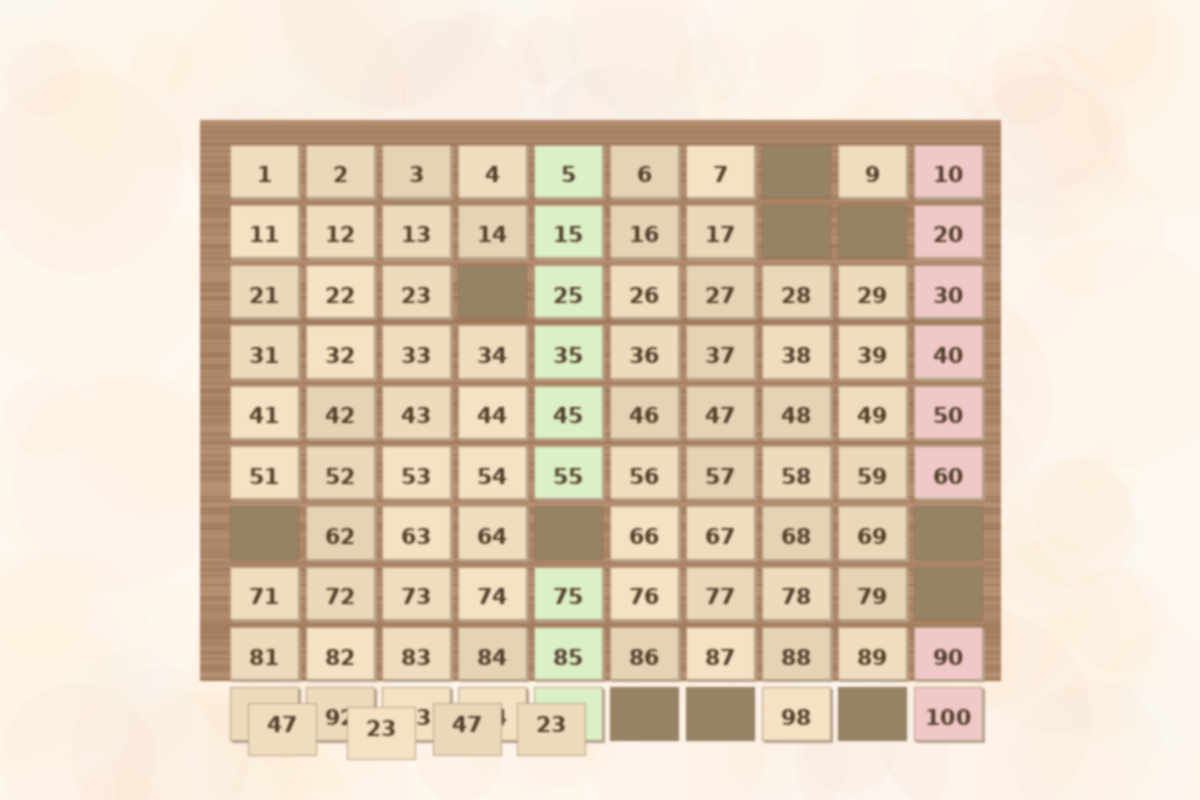
There is a moment of quiet magic when a child places the last tile on the Hundred Board and steps back to see the entire landscape of numbers from 1 to 100 stretching before them in perfect, orderly rows. It's a moment of genuine accomplishment — and a doorway into the magnificent world of mathematical patterns. The Montessori Hundred Board is one of those beautifully simple materials that grows with the child, offering layer upon layer of discovery: counting and sequencing at first, then odd and even numbers, skip counting, addition patterns, and so much more. Today's lesson explores this classic material and all the ways it can ignite a love of numbers in your home.
🧮 Why the Hundred Board Matters
In the Montessori math sequence, children move from concrete materials like the Number Rods and the Golden Bead Material toward increasingly abstract representations of number. The Hundred Board sits at a beautiful intersection: it is still tactile and hands-on (the child physically handles each tile), yet it introduces the abstract written numeral in a structured, visual format.
Working with the Hundred Board helps children:
- Recognize numerals from 1 to 100 with confidence
- Understand number sequence — what comes before, after, and between
- Discover the structure of our base-ten system — noticing how each row ends in a number with a zero, how the tens digit changes at the start of each new row
- Develop concentration and order — placing 100 tiles requires sustained focus and a love of precision
- Prepare for skip counting, multiplication, and arithmetic through pattern recognition
This material is typically introduced around ages 4–5, after the child has had experience with the Short Bead Stair, the Teen and Ten Boards, and linear counting. However, even younger children who can recognize numerals to 10 can begin working with a portion of the board, and older children (6–8) will find rich extensions in pattern work and skip counting.
🎒 Materials You'll Need
- A Hundred Board — a wooden board with a 10×10 grid and 100 numbered wooden tiles
- A work mat or table — the child needs space for the board plus a container of tiles
- A small basket or box — to hold the tiles before placement
- A control chart — a printed 1–100 grid the child can use to self-correct (see free printouts below)
- Optional: colored transparent chips or small markers for pattern activities
- 👉 Coogam Wooden Math Hundred Board 1-100 on Amazon
- 👉 MONTESSORI OUTLET Hundred Board on Amazon
📋 Presenting the Hundred Board — Step by Step
Initial Presentation: Placing Tiles 1–100
This first presentation is simple and beautiful. The goal is for the child to place all 100 tiles in the correct order on the board. Follow the Three Period Lesson approach if the child is still learning to recognize certain numerals.
- Invite the child: "I'd like to show you something special today — the Hundred Board. Would you like to work with it?" Carry the board and the box of tiles to the workspace together.
- Introduce the board: Run your finger along the empty grid. "This board has 100 squares, organized in rows of ten. We're going to fill it with tiles, starting with 1."
- Model the beginning: Take the tile numbered 1 from the box and place it in the top-left square. Find tile 2 and place it to the right. Continue through 10, showing that the first row holds 1–10.
- Continue to the second row: Place 11 in the first square of the second row. Say the number aloud: "Eleven." Place 12, 13, and so on. After a few tiles, pause and invite the child: "Would you like to find the next one?"
- Let the child take over: Most children will eagerly begin searching for tiles and placing them. Resist the urge to correct immediately — if a tile is misplaced, the child will often notice on their own as they continue. If they become stuck, gently ask, "What number comes after 34?"
- Celebrate completion: When the board is full, invite the child to look at the whole board. "You placed every number from 1 to 100! Look at this — isn't it wonderful?" Let them admire their work before carefully removing the tiles and returning them to the box.
Tip: For younger children or those new to the material, start with just tiles 1–10, then 1–20, gradually expanding as their confidence grows. There is no rush — the child may happily work with tiles 1–30 for weeks before wanting to complete the full board.
🔢 Extensions and Pattern Activities
Once the child can place all 100 tiles with confidence, the Hundred Board becomes a powerful tool for discovering mathematical patterns. These extensions are where the real excitement begins!
Extension 1: Odd and Even Numbers
- Have the child fill the board completely.
- Introduce the concept of even numbers: "Let's look at the numbers we land on when we count by twos — 2, 4, 6, 8…" Place a colored chip on each even number.
- Ask the child what they notice. (The chips form vertical columns!) The numbers without chips are odd.
- Remove the even tiles entirely from the board so the child can see the "holes" — this creates a striking visual pattern.
Extension 2: Skip Counting
Skip counting on the Hundred Board is visually stunning and connects beautifully to work with Counting Chain Arrows, bead chains, and the 100 Golden Bead Snake — where ten ten-bars laid end to end make a chain of 100 beads that the child can physically count and label with the same arrows used on the Hundred Board.
- Count by 2s: Place chips on 2, 4, 6, 8… The child sees vertical stripes.
- Count by 5s: Place chips on 5, 10, 15, 20… Two neat columns appear!
- Count by 3s: Place chips on 3, 6, 9, 12… A beautiful diagonal pattern emerges. Children are often astonished by this!
- Count by 9s: Place chips on 9, 18, 27, 36… Another striking diagonal, going the opposite direction.
- Count by 10s: The chips form one single column on the far right — a powerful visual lesson in our base-ten system.
Each of these patterns is a stepping stone toward multiplication. When a child can see that counting by 3s creates a diagonal pattern, the multiplication table is no longer an abstract memorization task — it's a pattern they've discovered with their own hands.
Extension 3: Finding Hidden Numbers
- Fill the board completely, then ask the child to close their eyes.
- Remove 5–10 tiles from the board.
- Ask the child to figure out which numbers are missing and place them back. This strengthens number recognition, sequencing, and logical reasoning.
Extension 4: Adding on the Hundred Board
For children ready for arithmetic, the Hundred Board provides a visual model for addition:
- Place a chip on 23. "Let's add 10. Move down one row — where do we land?" (33!) The child discovers that adding 10 means moving straight down.
- "Now let's add 5 to 23. Count 5 spaces to the right." (28!) This connects to the Snake Game and other addition work.
Extension 5: Reverse Placement
Place the tiles on the board starting from 100 and counting backward to 1. This is surprisingly challenging and wonderful practice for reverse sequencing!
🔎 Free Printouts
Use these free printable resources to extend the Hundred Board lesson:
- 📄 Counting 1–10 — Foundation practice for younger learners
- 📄 Counting Cards Set 1 (1–25)
- 📄 Counting Cards Set 2 (26–50)
- 📄 Counting Cards Set 3 (51–75)
- 📄 Counting Cards Set 4 (76–100)
- 📄 Counting Chain Arrows — Perfect for skip counting alongside the Hundred Board and for connecting to the 100 Golden Bead Snake (ten ten-bars laid end to end)
- 📄 Counting Arrows (Blank) — Create your own counting chain labels
🌿 Tips for Parents and Educators
- Follow the child's pace. Some children will want to place all 100 tiles on their very first try. Others will happily work with just the first two or three rows for many sessions. Both approaches are perfect.
- Provide a control chart. A completed 1–100 grid allows the child to self-correct without adult intervention. This builds independence and protects the child's concentration. Place it nearby, face down, so the child can check their own work when they choose.
- Prepare the environment thoughtfully. The Hundred Board works best on a large, uncluttered surface where the child can spread out. A floor mat is ideal. Read more about preparing the environment for your child.
- Let discovery happen naturally. When a child notices a pattern — "Look, all these numbers end in 5!" — resist the temptation to launch into a full lesson. Simply affirm: "You noticed that! I wonder what else you can find." The child's own discovery is far more powerful than any explanation we could give.
- Connect to other materials. The Hundred Board pairs beautifully with the Golden Bead Material (the child can see that 10 golden beads = one row on the board), counting games, and the bead chains used in skip counting.
- Use sensorial preparation. The ability to discriminate visually between similar numerals (like 6 and 9, or 12 and 21) is supported by earlier sensorial education work. If a child frequently confuses numerals, more time with sensorial activities may help.
🌟 What to Observe
As your child works with the Hundred Board, watch for these signs of growth:
- Increasing speed and confidence in placing tiles — a sign that number recognition is becoming automatic
- Self-correction — the child notices a mistake and fixes it without being told
- Pattern language — the child begins commenting on patterns: "This column is all the 'fives'!" or "Every other number is even!"
- Desire for extension — the child asks, "What about counting by sevens?" or begins experimenting independently
- Deep concentration — sustained, focused work is the hallmark of meaningful Montessori engagement
The Hundred Board is a material that a child may return to again and again over months or even years, finding something new each time. In its quiet simplicity, it holds the entire structure of our number system — waiting for small hands and curious minds to uncover it, one tile at a time.