Montessori Fantasy Versus Reality
Published on: March 23, 2026
If you've ever wondered whether Montessori education leaves room for imaginative play, you're not alone. It's one of the most common questions parents ask, and it deserves a thoughtful answer. I've been revisiting a wonderful article by Dr. Mario M. Montessori — Maria Montessori's grandson — called Fantasy and Reality in Children's Games, and I'd love to share some key insights with you. His writing beautifully clarifies the relationship between fantasy play and the purposeful work we see in a Montessori classroom, and I think it will resonate with today's parents just as much as it did when it was first published.
The Debate Over Play in Montessori Education
Montessori education has always sparked debate about the role of play. I think this article does a wonderful job clarifying where fantasy and structured work each fit in a child's development.
In the past school critics believed that the children were allowed to do whatever they pleased and that as a result they played freely all day. Today's critics believe the contrary: that in a school applying her system, the children are compelled to do only what Maria Montessori allowed, thereby having no free play.
Dr. Mario Montessori goes on to explain that when Maria Montessori first developed her approach, schools for small children were rare. Children were either segregated from adults in a nursery with toys and a nanny to watch over them, or — in poorer families — left to fend for themselves.
The toys one could buy were generally beautiful and ingenious but not sufficiently adapted to the child's developmental needs. Toy manufacturers were inspired mainly by the "child that is in the man" (das Kind in Manne). In other words, the creation of toys was determined by the adult's reaction to them rather than by their suitability for the child in his play activity. The adult considered child's play to be an aspect of infantile expression rather than the very important fundamental expression of man's behavior during the first stage of his development.
Montessori studied children in their own world. She would carefully observe a child's expressions and reactions to toys in the environment — an approach that still guides how we present materials today.
Two Types of Play: Autoexpression and the Organized Game
Dr. Mario M. Montessori offers deeper insight into play and work in Fantasy and Reality in Children's Games. He explains that a child's spontaneous expressions and behavior can be divided into two main areas.
1. Autoexpression — The Free Game
1. Autoexpression. Here events develop themselves, from the inner to the external. The child uses play materials as tools to express the results of his inner experiences, the products of his imagination or fantasy. In other words, the child's inner feelings are exteriorized through use of play materials and games which give meaning to these feelings. This is what we generally call the free game.
The less the materials are complicated, organized, or linked to specific differentiations, the more appropriate they are for the goal. Therefore, clay, sand, water, little pebbles, colors, paper (preferably in large sheets) paints, and so on provide excellent opportunities for playing free games, when fantasy is uppermost in the child's play.
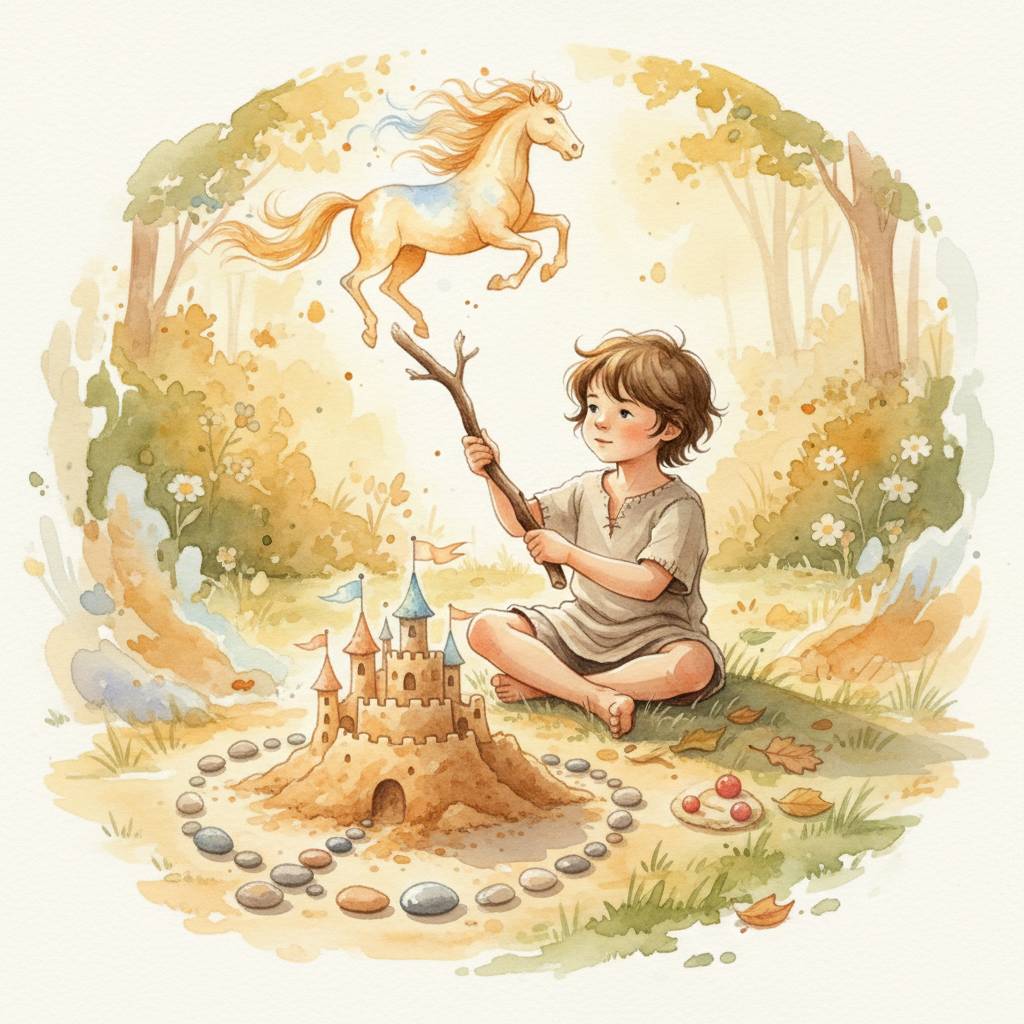
Fantasy play is a normal and healthy part of childhood. A fantasy box is a wonderful way to provide open-ended items for creative play. An old hose becomes a snake or a fireman's hose. Craft sticks become an airplane or a doll. Your child can create any part or object in this world — the simpler the material, the richer the imagination.
The Stick That Becomes a Horse
For example, a child with a stick between his legs indulges in the fantasy that he is a strong cowboy… If, instead of the wooden stick he were to have a wooden or real horse, the dream would not become more realistic to him.
The real horse might be more exciting to him, and the child might try to have contact with him, to feed him, to caress him, or to ride him; however, he would be no longer a cowboy, but rather a child in the presence of a big animal, absolutely conscious of their respective proportions and also conscious of his weakness in comparison to the animal.
When real elements are introduced into a child's fantasy play, the child is actually pushed out of fantasy and into reality. The wooden stick can be anything the child wants it to be. In this case, the stick-as-horse is the bridge between fantasy and reality — it holds both worlds together in the child's mind.
Why Adults Can't Direct Fantasy Play
Whenever a child, alone or in company of other children, is engaged in a game of fantasy, the adult can offer little help. Only the child who plays in this world of fantasy knows exactly how it must be organized and the specific meaning he wants to give each item he uses. The play materials can give his fantasy an aspect of reality without disturbing the imagination with specific qualities: therefore this type of play material must not be distinctive in itself, must not represent reality.
In all the games involving fantasy several aspects of child development can be studied, especially with regard to the emotional components. The child creates such games as a result of his personal experiences, and he proceeds consciously toward their elaboration. However, this type of activity does not provide the child with a precise view of the world in its objective qualities, such as the characteristics of things in the environment and their interrelationships, or the rules of his environment. Through fantasy the child himself gives shapes to everything and fits reality into his make-believe world.
This passage always reminds me of Christopher Robin leaving the Hundred Acre Wood — saying goodbye to Pooh Bear and friends as he grows up and enters the world of reality. I always thought it was a little sad he had to leave when he grew up.
The Organized Game — Where Montessori Materials Come In
The second type of play behavior is grounded in Montessori's research and materials. It is called the organized game.
2. The Organized Game. When the child's fantasy is interrupted by external resistance or reality refuses to be adapted, his attention is recalled, the situation becomes fundamentally changed, and the child's attitude toward the exterior world changes accordingly.
Dr. Mario Montessori explains that while a child is absorbed in fantasy play, he or she can be drawn back to reality at any time — a child playing cowboy outdoors might be distracted by birds singing or a fire engine passing by.
Thus, if the child encounters a specific interference or obstruction which requires intelligent attention, if he discovers something new and interesting, either in the external world or in himself, he forgets his world of fantasy and directs his curiosity toward the real situation.
When the child is attracted by specific, concrete qualities of some material with which he wishes to "play," either on the basis of its specific use or because it is part of a collective activity in which he wants to participate, he must submit to the disciplinary "rules of the game," and as a result he is working unconsciously at the inner construction of his personality. In this sense we are discussing "autorealization" rather than "autoexpression." The child must develop within himself the kind of behavior he will need in order to move independently and logically in his world; this, of course, will develop in relation to his innate nature, his intellectual and physical capacity, and according to his own rhythm.
So the child begins to move from internal expression to a more concrete understanding of the world. The impressions of life are being categorized into intellectual building blocks. This occurs within the realm of reality — and it's exactly what Montessori's sensorial education is designed to support. Maria Montessori used her materials in a mathematical, purposeful way to help children organize their sensorial impressions within a concrete reality.
The initiative to adhere to real things now comes from the child himself as he explores and experiments with reality. Real things in the environment have their own meanings, their own characteristics, value, and possibilities of application. The world shows a definite structure in which there are different principles of order as well as different, distinct forms with their specific laws and mutual relationships.
A child starts to define the world. The stick that was a horse is now a piece of wood — and wood comes from trees, birds live in trees, and so on. The world has its own rules: day and night, less and more, big and little, heavy and light, sweet and sour. Math and science come to the forefront.
From Fantasy to Social Awareness
Different situations in life require different forms of behavior and social relations. In order to belong to a group, one must accept the rules and the customs which govern that group. When the child voluntarily directs his attention to his environment, he no longer tries to externalize his own feelings or imagination but instead tries to learn and know about things as they really are. He now has the impulse and need to become one with his world.
To no longer believe the world revolves around you — and to want to be part of the world — brings to mind how many people observe that during the process of normalization, children develop a kind of obedience. But it's an obedience that comes from within, not from external pressure. Caring and love are part of this growth. With the intellectual change comes a social change. Some would even say a child is beginning to understand morals — what is good and bad, right and wrong. Activities in practical life help nurture this social awareness every day.
Why Montessori Called It "Work"
Montessori calls this aspect of the child's behavior "work," and we will designate this with the term organized play. The direction of events in organized play is now reversed: it is addressed inwardly by the child. While in the free game the child's creativity is manifested in conscious representation which can be verbalized or expressed by actions or with concrete and visible results, the creativity in organized play is unconscious, proceeding in an abstract and invisible manner.
Maria Montessori first developed concrete materials for preschool children — materials with built-in rules and methods. During this period, a child becomes normalized and develops an internal understanding of behavioral rules, laws of nature, mathematics, and more. She felt that this transition from fantasy to concrete learning was essential for later abstract thinking.
Under these circumstances, in organized play the adult can help. Along with guidance, understanding, and love, during this period of his development the child needs to be given those "organized toys" which we call materials.
The Montessori material is designed to provide the child with a key for his future discoveries of his world. This, however, is possible only when the material is presented correctly and when the child has reached the right stage of development to receive it.
Maria Montessori was deeply concerned with concrete learning for the preschool child. For example, if a child doesn't understand the concepts of large and small, larger or smaller, it becomes difficult for them to grasp math. Fantasy play does not involve this type of concrete thinking. Concrete learning is based in reality, whereas fantasy play belongs to the child's inner universe.
Because Maria Montessori first worked in mental institutions, she may have been especially concerned about children who did not want to leave the world of fantasy and resisted engaging with reality. It seems her grandson, Dr. Mario M. Montessori, understood that fantasy play is a natural part of development — a stage that eventually gives way to reality.
Materials for Creative Play at Home
If you'd like to support both types of play at home, consider providing simple, open-ended materials for fantasy play alongside purposeful Montessori-inspired activities. For outdoor imaginative play, a Costzon Mud Kitchen — Wooden Toy Playset offers wonderful opportunities for sand, water, and nature-based free play. For indoor creative expression, a Kids Art Easel with Drawing Tablet gives children the large-surface painting and drawing space that Dr. Mario Montessori described as ideal for autoexpression. Pair these with early practical life activities, and your child will have a rich balance of both fantasy and purposeful work.
Key Takeaway: Fantasy and Reality Work Together
The most important lesson from Dr. Mario M. Montessori's article is that fantasy play and organized, purposeful work are not opposites — they are two sides of the same developmental journey. Fantasy play lets young children express their inner world and process emotions. Organized play with Montessori materials helps them build a concrete understanding of the outer world. Both are essential, and both deserve a place in your child's life.
As parents, our role is to honor the fantasy stage without rushing it, while also providing the real, hands-on experiences that help our children discover the order and beauty of the world around them. Trust the process, follow your child, and know that imagination and reality will find their natural balance.