Montessori Phonogram & Vowel Reading Lessons
Published on: November 14, 2012
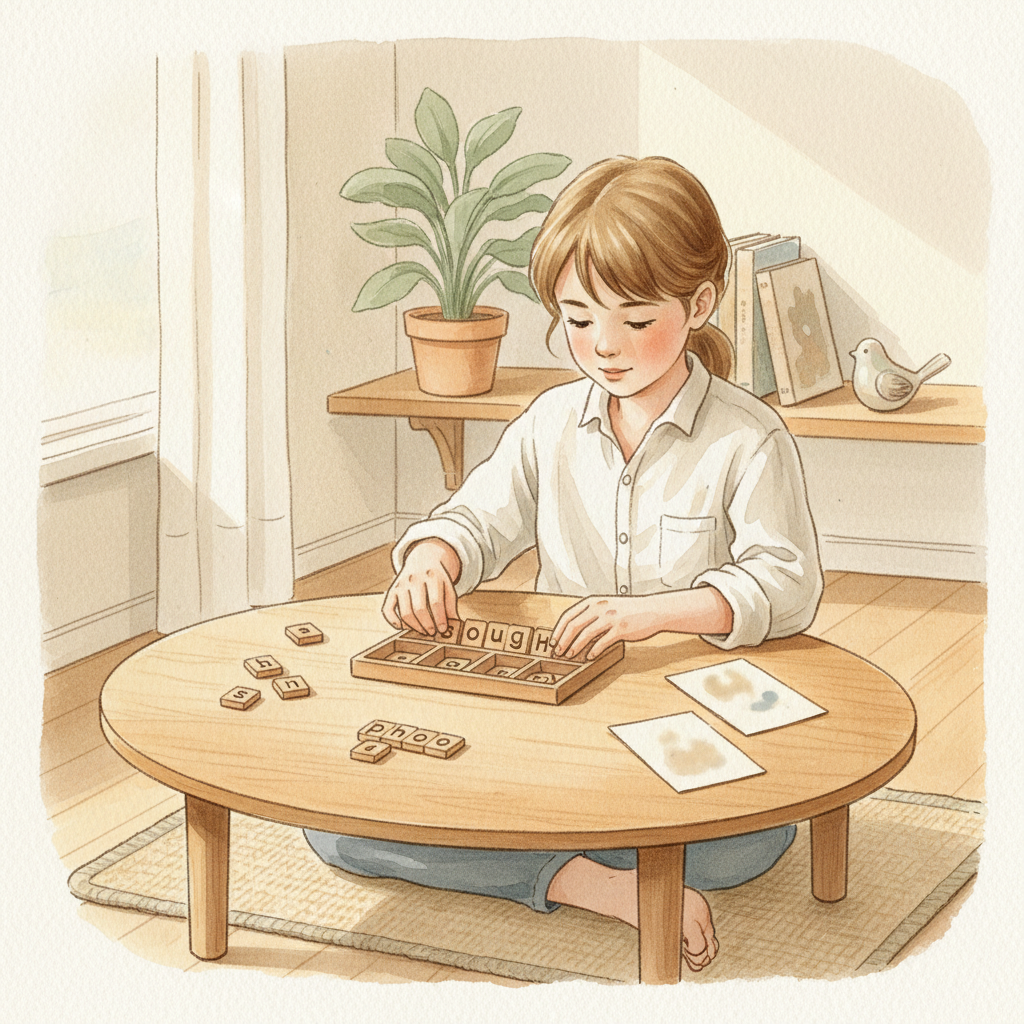
Four hands-on materials to guide your child from basic phonics into vowel teams and phonograms.
Once your child has confidently mastered the basic phonic sounds for reading, they're ready for a wonderful next step: learning the phonograms and digraphs that make English such a rich and interesting language. These lessons gently introduce the idea that letters often team up to make a single sound. To keep things fresh and engaging, we'll prepare four different types of materials, so your child can choose how they'd like to work.
A Quick Word on Phonograms and Digraphs
A digraph is simply a combination of two letters that together make one sound, such as the ai in "rain" or the ea in "tea." Phonograms work in much the same way, capturing the sound patterns that appear again and again in common words. The four materials below all explore these same patterns, just in slightly different forms — which is exactly what keeps children interested.
1. Phonogram Boxes
This is a collection of cards with words and matching pictures, organised by sound group. Each box holds one phonogram or digraph drawn from the most common words in the language.
Make a set of word cards on note cards, and a second set of cards with pictures that match those words. Label the outside of each box with the phonogram it contains.
For example, one box might hold ai words:
- pail
- nail
- rain
- train
- tail
- rail
The next box might hold ea words:
- pea
- seat
- tea
- leaf
Your child reads each word and matches it to the correct picture. If this proves difficult at first, make a single word card that also has the matching picture in the top left corner, so it can act as a gentle guide. As your child grows more confident, keep adding new boxes for new sound groups.
2. Booklets
For this material, use small notebooks in different colours — inexpensive assignment notebooks work perfectly. Write the phonogram or digraph on the cover, and then write just one word on each page.
For example, an oa booklet might read:
- soap
- coat
- goat
- toad
- loaf
Make several booklets, each for a different sound group, and let your child read through them. This exercise is a little more challenging than the boxes, because there are no pictures to offer reading clues — your child relies on the sound pattern alone.
3. Word Lists
The third material is a simple word list for each phonogram or digraph. Write the lists out by hand on sheets of paper, or type them on a computer. Here's the lovely touch: write the target sound in each word in a different colour, so it stands out and your child's eye is drawn to the pattern.
For example, an ea list might read:
- pea
- meat
- seat
- bean
- team
Your child simply reads down the list, noticing how the same sound repeats.
4. Envelopes
The fourth material gathers together several phonograms that share the same sound — for instance, ea, ee, ie and y can all make a long "e" sound. Each small group of words goes into its own envelope, with the sound written on the outside. All the small envelopes then live inside one large envelope, with every sound listed on the front (ea, ee, ie, y).
Inside the ea envelope are cards, each with a single word:
- pea
- meat
- seat
- bead
- bean
Inside the ee envelope:
- bee
- tree
- reel
- eel
- feet
Inside the ie envelope:
- field
- yield
- priest
- fiend
- pier
And inside the y envelope, where y takes on an "e" sound:
- candy
- dolly
- holly
- very
- bunny
Once again, your child reads through the words in each packet — and gradually discovers that very different-looking spellings can share the very same sound.
Extensions
To deepen the work, offer two small moveable alphabets in two different colours. Use one colour for the phonogram or digraph letters and the other colour for the remaining letters, so your child can build the words and see the sound pattern stand out as they do.
You can also provide coloured pencils and small notebooks so your child can write the words themselves, copying the colour idea from the word lists.
Tying It All Together
Your child can move freely between any of these four exercises. Wherever possible, try to use the same words across all four materials — the boxes, booklets, lists and envelopes. Repeating familiar words in different forms is a wonderful way to teach these trickier spellings without your child losing interest. Best of all, children love hunting for new words of their own and adding them to the growing phonogram lists.
Keep Exploring
Once your child is comfortable with these vowel teams, continue building their reading with Phonogram Words word lists, Montessori Reading Cards, the Moveable Alphabet.
Free Printouts
Download and print these ready-made reading cards to get started right away:
- Green Series Reading Cards — Long Vowels & Phonograms (Set A)
- Green Series Reading Cards (Set B)
- Blue Series Reading Cards — Consonant Blends (Set A)
Recommended Materials
If you would rather buy ready-made materials than make your own, these are good options for working with phonograms and vowel teams: