The Stamp Game — From Concrete to Abstract Arithmetic
Published on: May 07, 2026
Lesson of the Day 66: Today your child will take a wonderful step forward in their mathematical journey — moving from the hands-on world of Golden Beads to the more abstract Stamp Game, where colorful tiles unlock the power of addition, subtraction, multiplication, and division with growing confidence and independence.
What Is the Stamp Game?
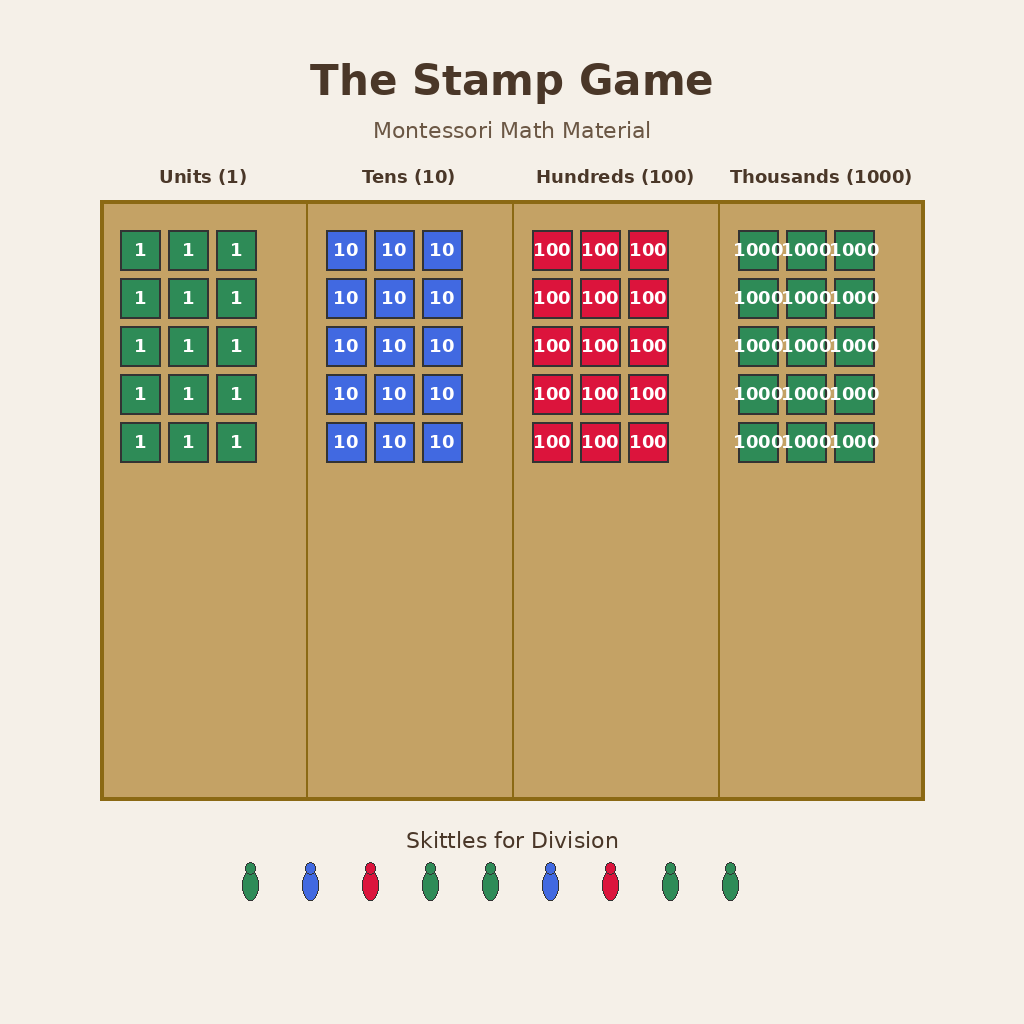
The Stamp Game is one of the most beloved and enduring materials in the Montessori math curriculum. It consists of a wooden box containing small, square tiles (or "stamps") that are color-coded to represent place value:
- Green tiles printed with "1" — representing units
- Blue tiles printed with "10" — representing tens
- Red tiles printed with "100" — representing hundreds
- Green tiles printed with "1000" — representing thousands
The box also includes small skittles (colored pegs) used for division work and colored number tiles for forming equations. If your child has been working with the Golden Bead material, they will immediately recognize the familiar color coding — green for units, blue for tens, red for hundreds, and green again for thousands. This continuity is intentional and deeply important. It allows the child to carry their understanding forward while the material itself becomes smaller and more symbolic.
The Bridge from Concrete to Abstract
In the Montessori math sequence, children begin with highly concrete, sensorial materials. The sensorial education and early math experiences lay the groundwork for understanding quantity, order, and pattern. When a child works with Golden Beads, they physically hold a single unit bead, a ten-bar, a hundred-square, and a thousand-cube. The size and weight of these materials communicate the value — a thousand-cube is large and heavy, while a unit bead is tiny.
The Stamp Game takes a brilliant leap: now every value is the same size. A "1000" stamp is no bigger than a "1" stamp. The child must rely on the numeral printed on the tile and the color to know its value. This is a critical abstraction — the child is moving from understanding quantity through physical sensation to understanding it through symbolism. It is a pivotal bridge on the way to pencil-and-paper arithmetic.
Signs Your Child Is Ready
Before introducing the Stamp Game, watch for these signs of readiness:
- Comfortable composing and exchanging with Golden Beads: Your child can build numbers using the Golden Bead material and understands that ten units equal one ten-bar, ten tens equal one hundred-square, and so on.
- Solid understanding of place value: When shown a number like 2,463, the child can identify which digit is in the thousands, hundreds, tens, and units place.
- Experience with static (non-carrying) addition: The child has successfully done addition with the Golden Beads where no exchanging is needed.
- Interest in larger numbers and operations: You may notice your child wanting to do more problems or asking about subtraction and multiplication — a sure sign they are ready for the next step!
- Familiarity with other sequential math work such as the Snake Game for addition or the Number Rods.
What You'll Need
- A Montessori Stamp Game set (includes stamps, skittles, and operation tiles)
- A work mat or small rug
- Paper and pencil for recording equations (when the child is ready)
- Number cards or printed equation slips — you can find these on our free math printouts page
DIY Option for Homeschoolers
If you'd like to make a stamp game at home, cut small squares of cardstock or craft foam in green, blue, red, and green. Write "1," "10," "100," and "1000" on the corresponding colors. Place them in a divided box or small containers. While a manufactured set is sturdier and more precise, a handmade version works beautifully for getting started.
How to Present It
As with all Montessori lessons, present this material with calm, deliberate movements and minimal words. Sit beside your child (not across from them) and let the material do the teaching.
Step 1: Introduction and Building Numbers
- Open the Stamp Game box and invite your child to explore the stamps. Ask them to notice the colors and the numbers printed on each tile.
- Connect to prior knowledge: "Do you remember the Golden Beads? The colors are the same — green for units, blue for tens, red for hundreds, and green for thousands."
- Give your child a number card (for example, 3,245) and ask them to build it using the stamps: 3 thousand-stamps, 2 hundred-stamps, 4 ten-stamps, and 5 unit-stamps. Arrange them in columns from left to right — thousands, hundreds, tens, units.
Step 2: Static Addition (No Carrying)
- Write or present a simple addition problem, such as 1,234 + 2,412.
- Have your child build the first number in stamps in a row, then build the second number below it.
- Starting with the units, combine the stamps from both rows. Count the total in each column and record the answer.
Step 3: Dynamic Addition (With Carrying/Exchanging)
- Present a problem that requires exchanging, such as 1,457 + 2,368.
- After combining the stamps, if any column has 10 or more, the child exchanges 10 stamps of one value for 1 stamp of the next higher value — just as they did with Golden Beads.
- This "carrying" process is now done with small tiles rather than heavy bead materials, making it faster and reinforcing the concept abstractly.
Step 4: Subtraction, Multiplication, and Division
Once addition is mastered, follow the same progression for subtraction (including dynamic subtraction with borrowing), then multiplication (building the same number multiple times), and finally division (distributing stamps equally among the skittles). Each operation follows naturally from the child's growing comfort with the material.
The Montessori Connection
The Stamp Game sits at a crucial point in the Montessori math curriculum. It follows the Golden Bead material and typically precedes work with the Dot Game (or small bead frame), which leads the child even closer to abstract, written arithmetic. Maria Montessori designed this sequence so that the child never faces a jarring leap — each material gently removes one layer of concreteness while preserving the child's understanding and confidence.
What makes the Stamp Game especially powerful is its versatility. A single material serves all four operations and can be used for months or even years as the child tackles increasingly complex problems. It also allows for self-correction — if the answer doesn't look right, the child can recount the stamps and find the error themselves, building independence and problem-solving skills.
Practical Tips for Parents
- Don't rush past Golden Beads. The Stamp Game is most effective when the child has thoroughly internalized the concrete experience. If your child still needs to feel the weight of a thousand-cube, honor that need.
- Present one operation at a time. Master static addition before introducing dynamic addition. Master addition before moving to subtraction.
- Let the child work independently. After the initial presentation, step back. The beauty of this material is that children can set up and solve problems on their own.
- Use equation slips. Prepare small slips of paper with problems for your child to choose from. This gives them autonomy while ensuring appropriate challenge levels.
- Pair with pencil-and-paper recording. As your child gains confidence, encourage them to write the equation and answer. This naturally transitions them toward abstract math work.
Building Mathematical Confidence, One Stamp at a Time
The Stamp Game is a quiet marvel. It doesn't flash or beep or offer digital rewards — it simply invites your child to think, to organize, and to discover that numbers follow beautiful, reliable patterns. Each time your child exchanges ten unit stamps for one ten stamp, they are not just learning arithmetic — they are building deep, embodied understanding of our base-ten number system.
Trust the process, trust the material, and most of all, trust your child. The concentration you see as they line up those small colored tiles is the look of a mind constructing itself. What a gift you are giving them by honoring their pace and offering them materials that meet them exactly where they are. You're doing wonderful work — one lesson at a time.