Dwarf Planets
Published on: June 17, 2013
Dwarf Planets: The Small Worlds of Our Solar System
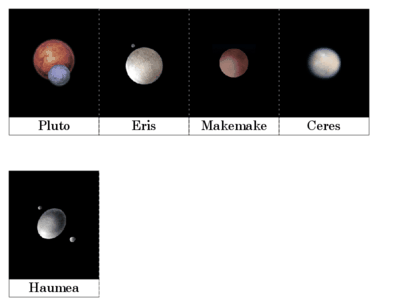
In 2006, the International Astronomical Union reclassified Pluto as a “dwarf planet.” In the Montessori spirit of following the child’s curiosity, this is a wonderful opportunity to teach that science is a living, evolving process.
These dwarf planet cards and lessons extend your child’s study of our solar system into these smaller but captivating worlds.
Free Printout: Dwarf Planet Cards
Our printable dwarf planet cards feature the five officially recognized dwarf planets with key facts and images.
Download Dwarf Planet Cards (PDF)
These cards pair perfectly with our Major Planet Cards.
What Makes a Dwarf Planet Different?
To be a planet, a body must: (1) orbit the Sun, (2) have enough mass for a roughly spherical shape, and (3) have “cleared the neighborhood” around its orbit. A dwarf planet meets the first two but not the third.
The Five Recognized Dwarf Planets
Pluto
Discovered in 1930, Pluto lives in the Kuiper Belt. NASA’s New Horizons flyby in 2015 revealed heart-shaped nitrogen ice plains and towering mountains. Pluto has five moons, including Charon.
Eris
Discovered in 2005, Eris is roughly Pluto’s size but 27% more massive. Its discovery triggered the dwarf planet reclassification. Named after the Greek goddess of discord.
Ceres
The only dwarf planet in the inner solar system, residing in the asteroid belt between Mars and Jupiter. NASA’s Dawn spacecraft discovered bright spots suggesting briny water once reached the surface.
Haumea
Located in the Kuiper Belt, Haumea has an elongated, egg-like shape caused by its incredibly fast rotation — one full spin in just about 4 hours. It has two moons and a ring.
Makemake
Pronounced MAH-keh-MAH-keh, named after the creation deity of the Rapa Nui people of Easter Island. The second-brightest Kuiper Belt object after Pluto.
Activities for Exploring Dwarf Planets
- Compare and Classify: Lay out both major planet cards and dwarf planet cards. What makes them different?
- Map the Solar System: Create a scale model including dwarf planet locations.
- Timeline of Discovery: When was each dwarf planet discovered?
- Size Comparisons: Use clay to compare dwarf planets to Earth’s Moon.
Recommended Materials
- Safari Ltd Solar System Figurine Set — Detailed planet models for hands-on learning.
- DK Eyewitness: Space Exploration — Visually rich reference book.
More to Explore on MontessoriMom
- Our Solar System
- Planet Cards
- Inner and Outer Planets
- The Sun
- Astronomy Printouts
- Space and Geography Lesson