Our Solar System
Published on: May 27, 2013
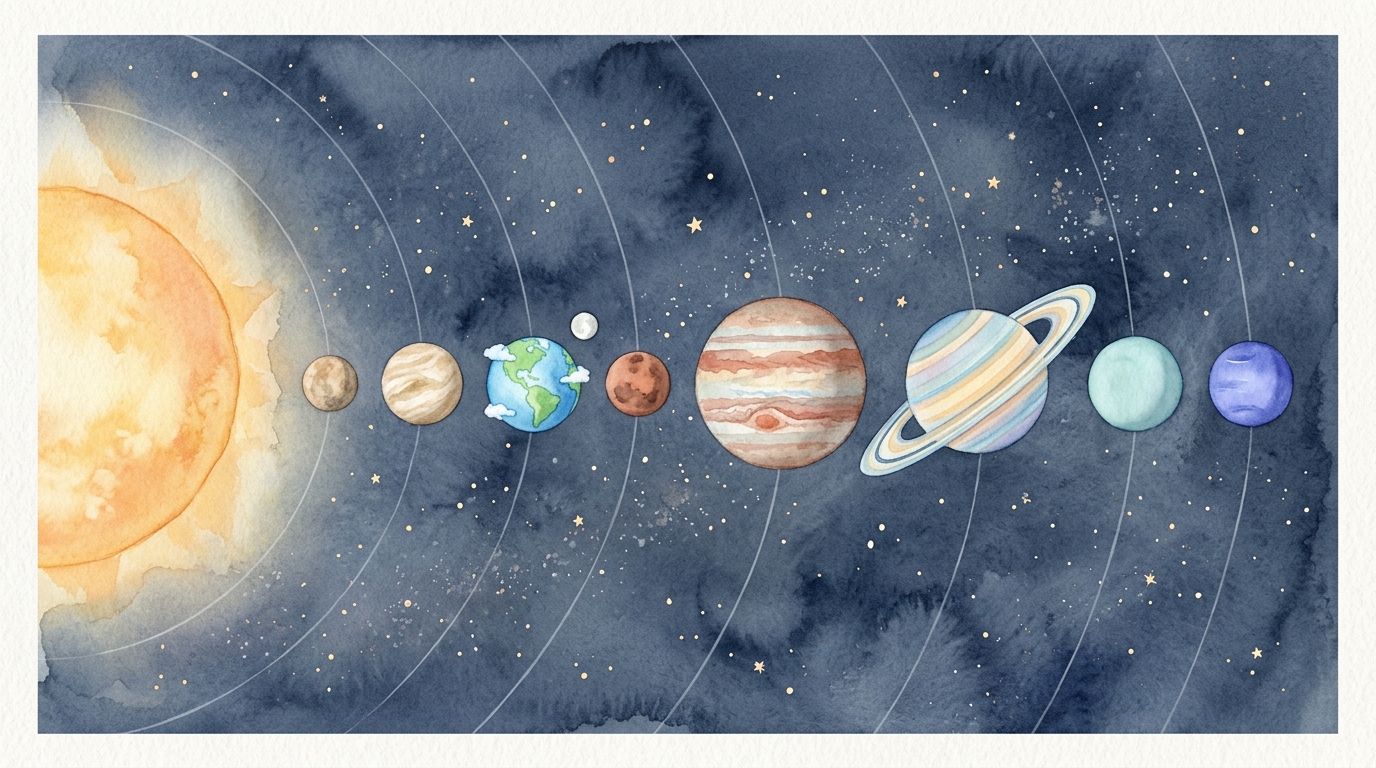
Our Solar System
When your child looks up at the sky, they are taking in the wonders of our solar system. During the day we can see the sun, and at night the moon, planets, and stars come into view. We live on Earth — one planet among many — and exploring our cosmic neighborhood is one of the most exciting journeys you can take together. Teaching children about the solar system fills them with wonder and helps them understand their special place in the universe.
The Sun: The Heart of Our Solar System
Our sun is a star that is alive and brimming with energy. It is a medium-sized, yellow star — still young enough to keep shining for at least another five billion years! The sun sits at the very center of our solar system, with all the planets circling around it. When children understand that the sun is the anchor holding everything together, they begin to appreciate just how connected all the parts of our solar system truly are.
The Eight Planets
There are eight planets orbiting the sun, and you can spot several of them shining in the night sky. Unlike stars, planets shine brightly but do not twinkle — a wonderful clue you can teach your child to look for!
Earth is the only planet we know of with animals and plants, because it has both oxygen and water. From space, Earth looks like a beautiful blue marble thanks to its vast oceans and the water surrounding its continents. Our sister planet, Venus, is almost exactly the same size as Earth, and it is the hottest planet of all. Mercury is the planet closest to the sun. Mars is smaller than Earth, but it shares a familiar feature — polar ice caps, just like ours! Jupiter is a gaseous giant with only a small amount of rock at its center. Each planet has its own personality, and children love discovering what makes every one unique.
Dwarf Planets
There are five dwarf planets in our solar system. Dwarf planets are smaller, round celestial bodies that orbit the sun just like the larger planets, but they are not considered moons. The main difference between a dwarf planet and a regular planet is simply its size. Pluto, which is the furthest from the sun, is one of these fascinating dwarf planets — a fact that often surprises children who learned it was once called a full planet!
The Moon and Its Phases
The moon circles the Earth, completing its orbit in less than 27 days. During Earth's solar year, there are 13 lunar cycles. The moon doesn't make its own light — instead, it reflects sunlight like a mirror, which is why it appears to change shape each night depending on how much light is reflecting toward us.
The moon is one of the easiest objects to observe in the night sky, and it even affects our ocean tides and weather. Watching the phases of the moon is a wonderful nightly ritual for families. You can print out the moon cards and place them on a chart or calendar, letting your child track each phase as it appears. A read-aloud like My First Book of Planets makes a lovely bedtime companion as you wind down after a night of stargazing.
Stars in the Night Sky
The night sky is full of stars, and they come in many varieties. Young stars are called blue giants — they are so enormous that they don't last very long. Older stars are called red dwarfs, and they are the longest-lasting stars of all. Our own sun is a yellow dwarf, still full of energy and life. Stars are born in clouds of gas and dust called nebulae. The opposite of a brand-new star is a black hole, which forms when a very large, old star collapses in on itself. These contrasts give children a beautiful sense of the life cycles happening all across the universe.
Constellations
For as long as people have gazed at the stars, they have imagined patterns in them. These star shapes are called constellations. The Big Dipper is a helpful signpost in the northern hemisphere, while the Crux — or Southern Cross — is easy to find in the southern hemisphere. Searching for constellations together is a delightful way to help your child connect with the same sky that has guided travelers for thousands of years.
Asteroids, Meteors, and Comets
Sometimes objects from space travel near our Earth. These can be asteroids, meteors, or comets. Asteroids are pieces of rock floating in space. Meteors are often called "shooting stars," even though they aren't stars at all — they are small bits of metal or rock zooming through space. Comets are like dirty snowballs made of ice and dust; as they move toward the sun, they develop a glowing tail. Children are endlessly fascinated by these wandering visitors!
Human-Made Objects in Space
The newest objects in our solar system aren't natural at all — they are made by people! These include the space station, satellites, and spacecraft. It's a wonderful reminder to children that humans are explorers too, sending our own creations out into the cosmos.
Bringing the Solar System Home
One of the best ways to deepen your child's understanding is to make the solar system something they can touch and build. A hands-on project like the Playz Solar System Model Kit turns abstract ideas into a tangible planetarium your child can assemble and explore, reinforcing everything they've learned about the sun, planets, and their orbits.
Free Printouts
These free, ready-to-print materials offer lessons, vocabulary, and nomenclature reading cards for studying the solar system. Print them out to use in your Montessori environment: