Summer Fun & Travel
Published on: June 30, 2007
Summer is my favorite season for learning that doesn't feel like learning. The days are long, the pace is slower, and there is time for the kind of unhurried, hands-on work that Montessori children love best — sand and water play, painting, chalk drawing on the sidewalk, cooking outdoors, and simply enjoying the sounds and wonders of nature.
Dr. Montessori was a great believer in freedom and independence — in every child's capacity to become a thoughtful, capable, kind person when given the right environment. Summer, with all its open space and open time, is a wonderful season to offer that freedom. If you'd like a little inspiration, her short essay “Have Faith in the Child” is a lovely read.
Here are five of our favorite ways to keep summer full of purposeful fun — four for close to home, and a new one for the road.
1. Walking the Line — Outdoors
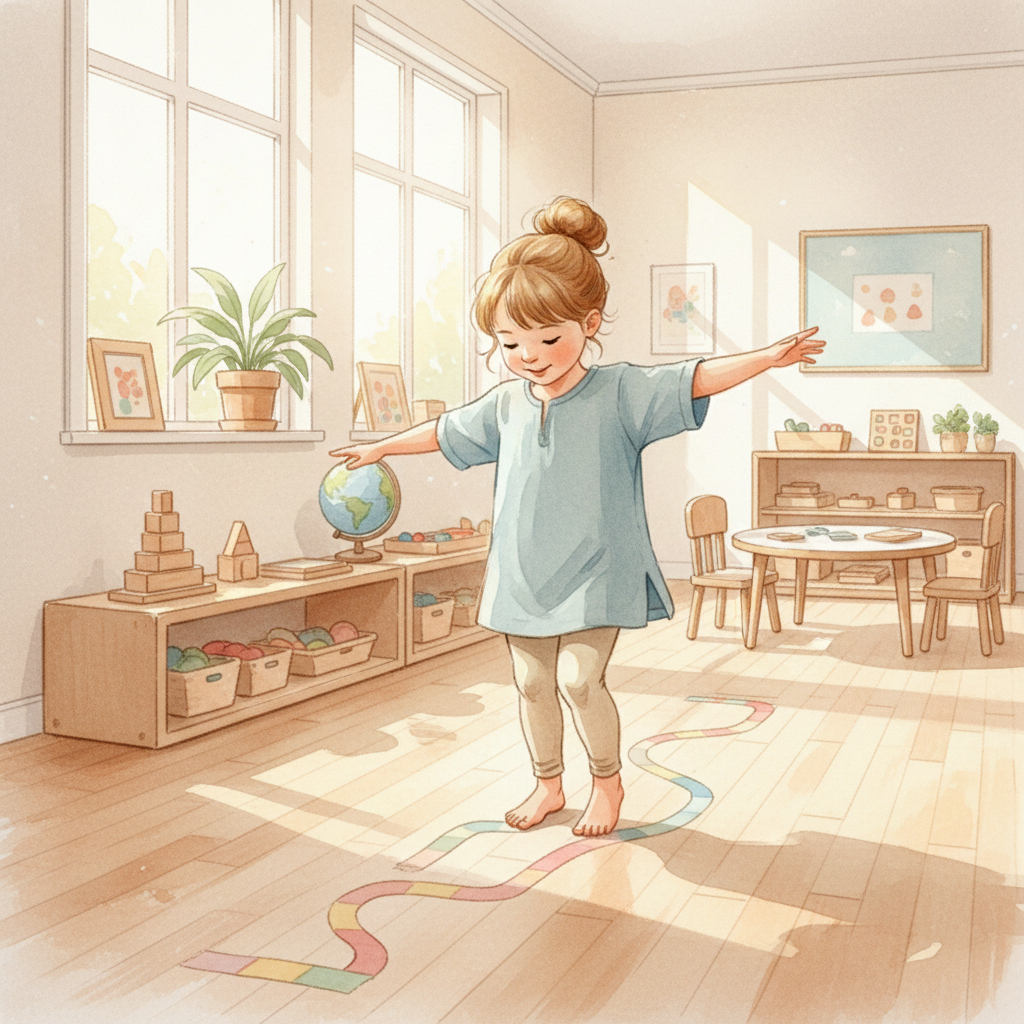
Walking the line is a classic Montessori balance and coordination exercise, and summer is the perfect time to take it outside — onto a patio, a deck, or a length of sidewalk chalk drawn right on the driveway. It builds coordination, balance, depth perception, and that lovely sense of the body and brain working together.
When your child first starts, keep it simple: just walking the line, one foot after the other, head up and posture tall, with nothing in the hands. As the skill becomes easy, you can gradually add something to carry:
- A small block or beanbag, held out to the side or in front.
- A small bell, a little flag, or a book balanced on the head (an elastic headband helps hold it steady).
- A cup or small pitcher — empty at first, then filled halfway with water, then fuller.
- A spoon holding a marble, then a spoon with a small amount of syrup.
Once your child has the hang of it, mix it up: walk backwards or sideways, march, tiptoe, skip, hop, or move to music. You can read the full lesson on our Walking the Line page.
2. Fun at the Zoo
A summer trip to the zoo is a natural science lesson. Bring a camera and let your child take lots of pictures — you can sort and talk about them at home afterward.
Free printout: Zoo & Plankton Animal Classification Reading Cards (PDF) — perfect for the classification activity below.
A wonderful activity for older children is to sort the animal kingdom into groups — mammals, reptiles, amphibians, fish, birds, insects, and so on. The San Diego Zoo Kids site and the Smithsonian's National Zoo both have beautiful photos and simple facts to help.
With younger children, keep it playful and observational. As you walk the zoo — or simply watch the animals right where you live — wonder aloud together:
- Does this animal have fur, feathers, scales, a shell, or skin?
- What kind of feet does it have? How many legs?
- Can it fly? Does it have a beak or a mouth?
At home, make a simple wall chart with the category names and let your child place pictures of animals under the right label. If your child isn't reading yet, add a small picture beside each word.
3. The Montessori Sandbox
There is so much to learn in a sandbox — landforms, waterways, rough and smooth, heavy and light, alike and different, and sound. It's just as fun at the beach. All you need is sand, water, a shovel and pail, a few recycled containers with lids, a spoon, two little pitchers, and a sieve or strainer.
Just digging is great for any age, but here are a few purposeful games to try:
- Pouring and sifting: pour sand from one pitcher to another, and sift it through a strainer to catch the pebbles and shells.
- Rough and smooth: have your child feel different things — sand, water, a smooth pail, grass, a rough rock, a shell — and sort them by texture.
- Heavy and light: place a big scoop of damp sand in one of your child's hands and a small pinch in the other, and let them tell you which is heavy and which is light. Take turns, and make it trickier as they get better.
Landforms in the sand. The sandbox is a beautiful place to introduce geography. Dig a hole with a channel leading into it, and let your child pour water down the channel — “this is a river.” The hole fills up: “this is a lake.” Pat a mound of sand in the middle — “an island.” Add sand to one side so water surrounds it on three sides — “a peninsula.” Push sand together from both sides to raise “a mountain.” You can shape a cape, an isthmus, a bay, and a cove the same way. For a volcano, hollow out a crater, add a few spoonfuls of baking soda and a drop of red food coloring, and slowly pour in vinegar so the “lava” flows out and hardens into a mountain. This illustrated landform glossary shows what each shape looks like, and our Land and Water Forms lesson takes it further with cards and definitions.
4. Camper's Delight — Outdoor Cooking
These little foil packets are a favorite hot-summer supper, and children can do nearly all the work themselves. Here's what you'll need:
- Pineapple chunks
- Green pepper, cut into large pieces
- Green onions
- Zucchini, cut into circles
- Cubed tofu seasoned with soy sauce, or chicken or turkey hot dogs
- Aluminum foil, a pastry brush, and a little oil
- Salt, pepper, onion salt, and garlic salt
Let your child gently wash and dry the vegetables. Younger children can cut the tofu or a hot dog with a serrated butter knife; more practiced hands can cut the zucchini. Give your child an 8-to-10-inch piece of foil and let them lightly brush it with oil, pile the vegetables, tofu, or meat on one half, and season it. Fold the foil over and crimp the edges tightly. The grown-up handles the fire: cook on a campfire or barbecue grill on high for about 15–20 minutes, turning the packet so it doesn't burn. Serve with rice or bread. Real work, real fire, real supper — the heart of practical life.
5. Summer Travel & On-the-Go
Summer often means travel — a long car ride, a plane, a visit to grandparents, a week away from home. You don't have to leave the Montessori spirit behind. A little preparation turns waiting time into some of the calmest, most focused play of the whole trip.
- Pack a small “travel work” bag. Just as a classroom shelf offers a few carefully chosen works, pack a handful of small, self-contained activities — a lacing card, a little tin of buttons to sort, a few nomenclature cards, a reusable water-reveal pad. Offer one at a time so each stays special.
- Keep a nature journal. A small notebook and a pencil are enough. Let your child draw a shell, a mountain, a new bird, or press a leaf between the pages. It builds observation and gives the trip a keepsake.
- Play observation games. “I Spy,” sound-hunting (“what do you hear?”), and color- or shape-spotting out the window sharpen the senses and pass the miles — no screen required.
- Follow the map. Give your child a simple map or let them watch the route, spotting rivers, lakes, and mountains you pass. It's real-world geography, and it pairs beautifully with our Map Skills lesson.
- Send a postcard. Choosing a card, writing a line, and mailing it is a complete little practical-life and language work — and a grandparent's favorite kind of mail.
Travel days ask a lot of young children. A few familiar, purposeful things to do — and plenty of grace and patience — make the journey part of the adventure rather than something to endure.
Recommended Summer & Travel Materials
A few things we like for the activities above (these are affiliate links — they help support the site at no cost to you):
- Click N' Play 18-piece beach & sandbox set — bucket with a built-in sifter, watering can, rake, and molds; everything you need for the sandbox games and landform play.
- Melissa & Doug Water Wow! reusable water-reveal pads (3-pack) — a mess-free, refillable travel activity for the car or plane; paint with plain water, let it dry, and use it again.